Essential Checklist for Plumbers Answering Service

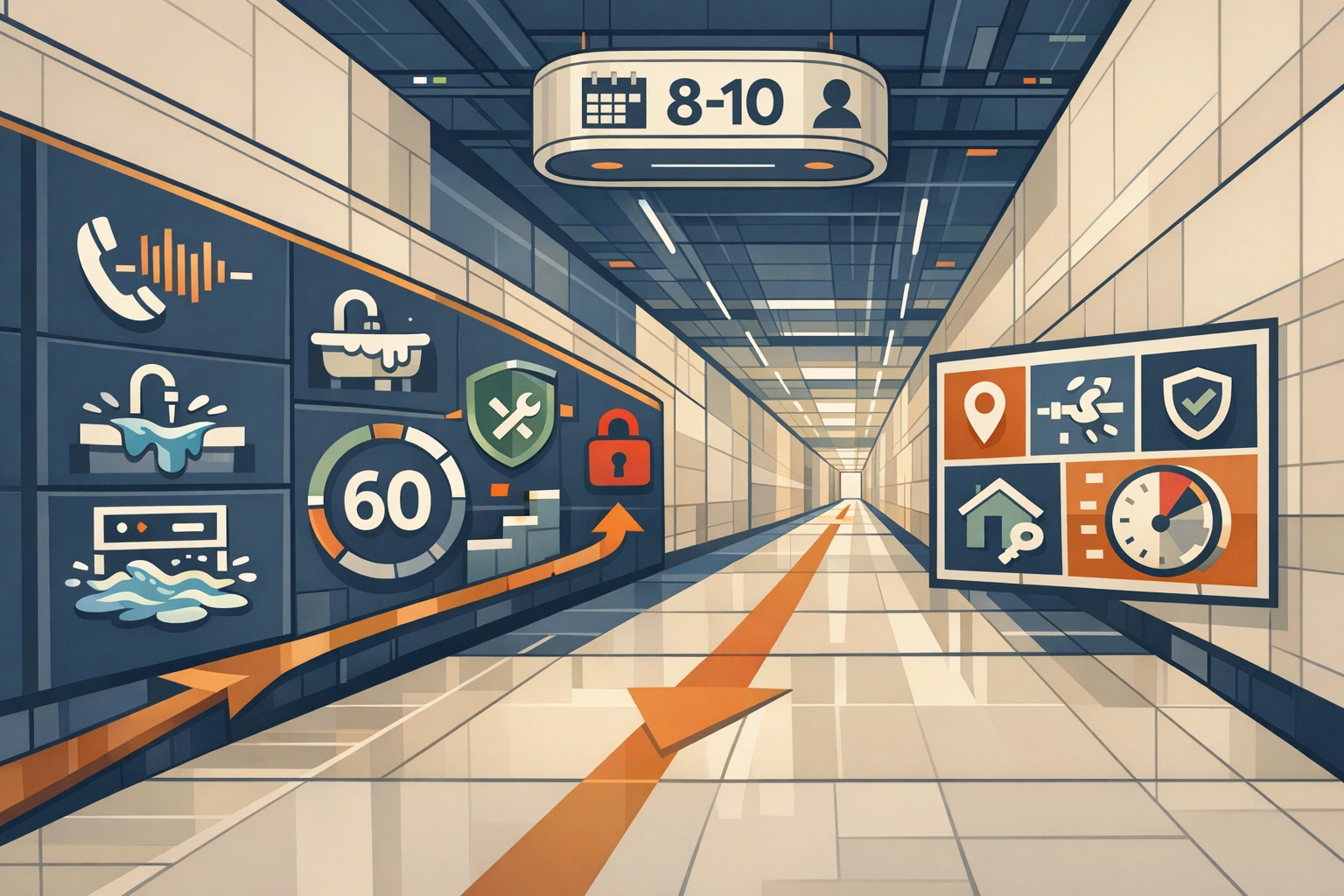
Plumbing teams lose booked jobs when after-hours calls end as vague notes, urgency is misread, time windows stay loose, access details are missed, and callbacks have no owner. This vendor checklist reframes an answering service for plumbers as an operating system: every call should produce one clean, dispatch-ready outcome that prevents Monday chaos and reduces morning re-calls.
It helps you pressure-test vendors on what actually matters in production: urgency vs routine triage rules (including safety cues), confirming a bookable two-hour window instead of “tomorrow,” capturing access constraints like gate codes or on-site availability, and delivering a structured handoff dispatch can execute without re-contacting the customer. It also surfaces governance questions vendors dodge, like how they prevent duplicate callbacks, assign one owner with an SLA, and prove quality with a repeatable QA scorecard.
Convin is mentioned only as a potential product solution company to support structured CRM logging, owned follow-up tasks, and automated QA and coaching tied to outcomes like bookings, reschedules, and complaints.
Most plumbing teams do not lose jobs because demand is low. They lose jobs when after-hours calls are handled with partial details and no clear follow-up. That is why choosing an answering service for plumbers is a revenue decision, not just a staffing one.
The real challenge is not answering the phone. It is ending every call with one clear, executable next step. A customer with a leak expects a defined plan and a realistic time window. Dispatch needs a handoff they can act on without calling back to re-confirm basics. Multi-shift teams need the same intake standard on weekends as they do on weekdays, so the morning queue is execution, not cleanup.
Customer: My kitchen sink is overflowing and water is spreading under the cabinets. I shut off the faucet but it is still backing up. Can someone come tonight?
Rep: I’m sorry you’re dealing with that. Let me get a few details so we can move quickly. Are any other drains backing up, like the dishwasher or a bathroom sink?
Customer: The dishwasher is filling with dirty water too.
Rep: Understood. That helps. We have an on-call technician available between 8 and 10 pm. I can reserve that window for you right now. Does that work?
Customer: Yes, that’s fine.
Rep: Great. I’m booking 8 to 10 pm. You’ll receive a confirmation text in the next minute. If anything changes, reply directly to that message and we’ll adjust.
Takeaway: The issue is rarely effort. It is the absence of a time-bound plan and a clearly assigned next step. Confirm an escalation path or a specific callback window before ending the call.
Explore a weekend-proof coverage scorecard
How Conventional AI Tools Support After-Hours Calls
AI support usually enters after-hours workflows to reduce missed calls and speed up intake. The most common approaches are useful, but only if they create dispatch-ready outcomes.
What Teams Commonly Implement
Some teams use automation to route calls and capture basic details. Others add scheduling messages to confirm appointments and send reminders. These patterns can improve coverage, but they still leave a few operational gaps that show up under real after-hours volume:
- “Emergency” routing that is too broad to be reliable
- Availability captured as “tomorrow” instead of a bookable window
- Notes stored as free text, forcing dispatch to re-call for clarity
- No consistent measurement, so performance varies by shift and vendor
The deciding factor is simple: the system must convert the call into a structured outcome that can be executed, not just a summary of what was said.
Check how windows become bookable ranges
This blog is just the start.
Unlock the power of Convin’s AI with a live demo.
Vendor Questions That Expose Real Capability
General guidance: Vendor questions should force clarity on what happens after the call, not just how the call is answered.
Use this table to pressure-test whether the vendor can run real workflows.
Preview proof of quality beyond training
Non Negotiables Checklist Before You Sign
General guidance: These are the minimum non-negotiables that prevent lead loss and morning chaos. If a vendor cannot meet them consistently, it will show up in missed bookings, duplicate callbacks, and dispatcher rework.
- Triage in under 60 seconds using severity, safety, a confirmed time window, and access constraints
- Predictable escalation rules for emergencies and safety cues, so the right on-call tech is alerted fast
- Bookable time windows captured as a clear range (e.g., 6–8 pm), not vague time words
- Owned callbacks with SLAs so follow-ups do not slip, and customers get one clear update
- Dispatch handoff fields that a different person can execute without re-calling for basics
- QA and coaching tied to outcomes like booked jobs, reschedules, and complaints, not generic call scoring
- Trigger-based outreach so customers are contacted when the state changes, not on fixed sequences
Require owned callbacks with clear SLAs
When After-Hours Volume Rises, Process Discipline Wins
After-hours coverage does not break because calls increase. It breaks when the system reacts differently depending on who is on shift or which branch sees the alert first. Consistency is not about policy language. It is about how each request moves from first contact to confirmed action without overlap or delay.
For a setup that stays steady under real weekend pressure, focus on operational clarity:
- Single active workflow per inquiry so one team is clearly advancing the request at any moment
- Next actions tied to real events such as a missed call, a booking window shared, a confirmation received, or a change requested
- Defined response windows for every return call instead of open-ended follow-ups
- Central visibility into customer status so teams are not acting on outdated information
- Clean system entries that reflect what was promised including urgency level, time window discussed, and confirmation state
- Regular pattern reviews to spot where bookings stall, reschedules increase, or complaints repeat
When this discipline is in place, weekend spikes feel controlled instead of chaotic. Dispatch receives clear, usable handoffs. Technicians arrive with the right context. Customers do not receive duplicate calls from different locations.
If you are evaluating solutions, look beyond pickup speed. Choose the option that keeps timing clear, follow-ups coordinated, and every after-hours interaction traceable from first ring to final outcome.
See CRM fields capture intent and outcomes
FAQs
- What should an answering service for plumbers deliver after every call?
An answering service for plumbers should produce one owned next step, a confirmed time window, urgency tag, access notes, and a dispatch-ready summary without re-calling. - How does an answering service for plumbers separate urgent vs routine?
Use severity and safety cues like active flooding, sewage backup, shutoff ability, and vulnerable occupants; escalate emergencies and route routine to booking. - What handoff fields must an answering service for plumbers provide dispatch?
Provide address and unit, symptom and job type, urgency level, two-hour window, onsite contact, access details, promised callback time, and owner queue. - How should an answering service for plumbers prevent duplicate callbacks?
Assign one owner queue per lead, log callback time with SLA, dedupe triggers per state change, and limit outreach to one attempt unless the customer opts in. - What non-negotiables matter when choosing an answering service for plumbers?
Demand 60-second triage, predictable escalation rules, bookable windows, SLA-bound owned callbacks, structured dispatch handoffs, and QA tied to outcomes and complaints.
Where Convin Fits In Plumbing Call Operations
Convin can sit alongside your phone system, scheduling tool, and CRM as an operations layer that turns after-hours conversations into trackable outcomes. It is most useful when the goal is not just answering, but running a consistent call workflow at scale.
How Convin Solves The Workflow End-To-End
Based on the provided product copy, Convin supports AI phone call handling, 24/7 inquiry handling, instant bookings and scheduling, follow-ups that never slip, CRM logging and automated follow-ups, Automated QA with coaching, and sentiment detection. In an after-hours plumbing workflow, Convin can:
- Detect urgency, safety risk, access constraints, and requested callback time
- Log a structured outcome in CRM (escalation, booked slot, callback) with time window and address
- Trigger owned, SLA-bound tasks so dispatch knows who owns what and by when
- Run automated QA to score triage completeness and next-step clarity
Operational Results
After-hours calls produce consistent handoffs instead of scattered notes. Ownership becomes clear, duplicate callbacks reduce, and QA becomes continuous. The practical impact is fewer lost leads, fewer reschedules from missing context, and fewer morning re-calls to confirm basics.
Customer: I can do tomorrow, but only after 6 pm.
AI Agent: Understood. I’ll set a callback at 6 pm today to confirm the booking.
Customer: Please do not call me five times. One clear update is enough.
AI Agent: Agreed. You’ll get one confirmation message after the callback.
System record: Callback requested after 6 pm. No task created.
Convin: Detects the time, logs it, and triggers an owned 6 pm task with an SLA.
Takeaway: The issue was missing task ownership. Convert callback requests into one owned, SLA-bound task the moment the time is stated.