HVAC Call Answering Service Explained: Why AI Is Taking Over

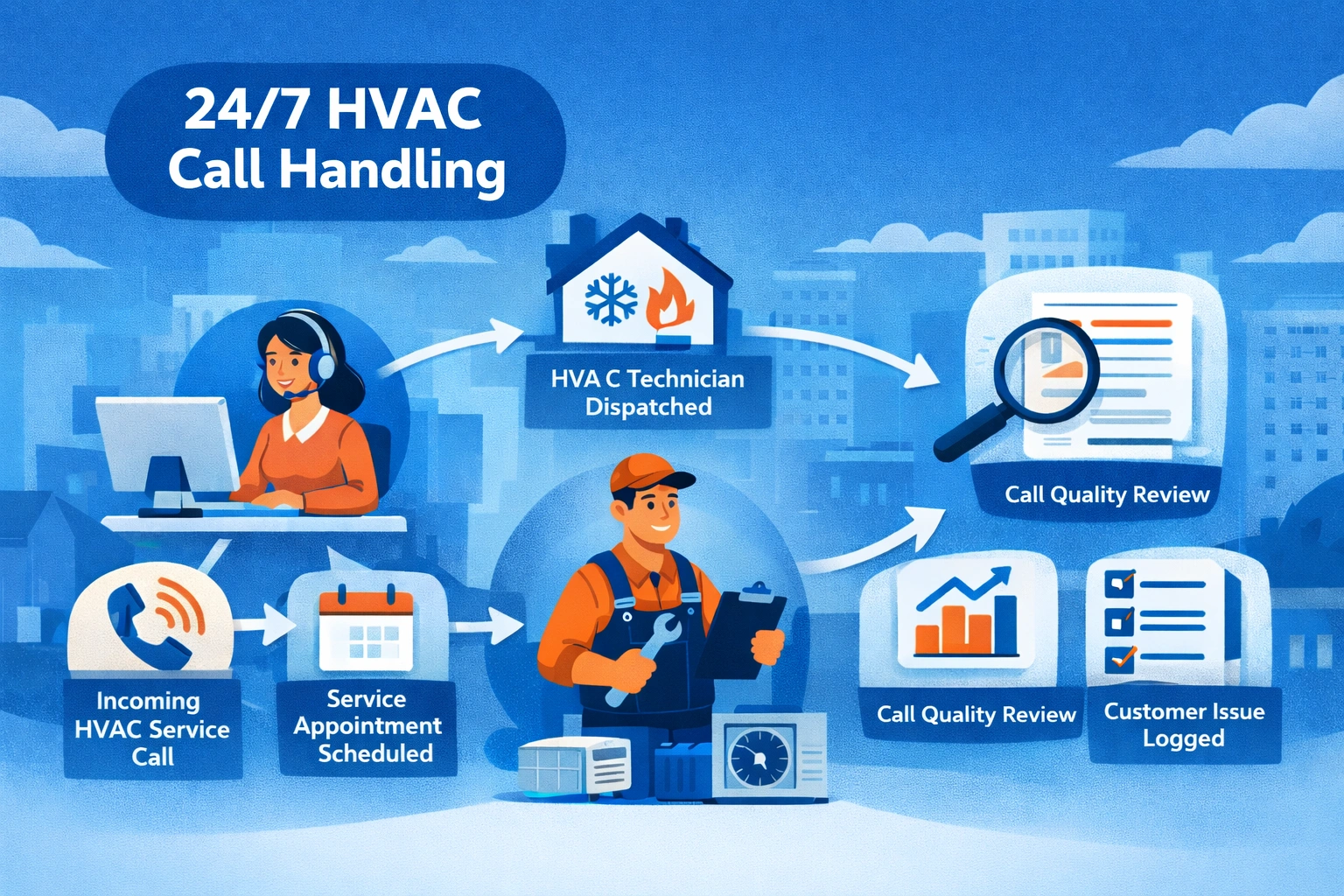
An HVAC call answering service helps businesses capture after-hours and overflow calls when no one is available to answer. While it improves availability and reduces missed calls, answering alone does not ensure quality or better outcomes. This blog explains how HVAC call answering services work, when they make sense, and why growing HVAC teams need visibility into conversations to improve call handling over time.
Most HVAC calls are missed at night, not during office hours, after them. A system fails at 11 PM. A heater shuts down at 3 AM. A homeowner needs immediate help. The phone rings. No one is available to answer. The call goes to voicemail.
By morning, that customer has already called someone else. This is the exact gap an HVAC call answering service is designed to fill. It ensures after-hours and night calls are answered by a real person. Not recorded, not delayed.
In this blog, we explain what an HVAC call answering service actually does. When it makes sense to use one. Where it stops adding value and how HVAC teams think beyond just answering night-time calls.
Analyze HVAC after-hours calls with Convin
How HVAC Call Answering Services Work
An HVAC call answering service is a third-party service. It answers calls on behalf of HVAC businesses. The goal is simple. Never let a call go unanswered. Most HVAC answering service providers follow a standard flow.
- Calls are forwarded from your main number
- Live agents answer using scripts
- Basic details are captured
- Messages are sent to your team
In HVAC phone answering service setups, agents work from predefined instructions and focus on capturing essential details. Their role is to respond quickly and log information accurately, not to handle complex issues. As a result, an HVAC call answering service is designed for speed and coverage rather than depth.
How HVAC phone answering service differs from in-house reception
In-house teams know your business. They know repeat customers. They understand urgency. An HVAC phone answering service does not. Key differences include:
- No deep HVAC product knowledge
- No real-time technician availability
- No ownership of outcomes
Where HVAC call handling service fits in daily HVAC operations
An HVAC call handling service usually supports:
- Overflow calls
- Peak seasons
- Weekend coverage
It works alongside your team, not instead of it. Many HVAC companies use an HVAC call handling service during growth phases, or during hiring gaps.
How HVAC after hours answering service supports emergency calls
HVAC emergencies happen after hours. Pipes burst at night. Heaters fail on weekends. An HVAC after hours answering service ensures:
- Calls get answered
- Customers feel heard
- Emergencies get logged
Review HVAC customer calls using Convin Auto QA
Why Answered Calls Create Value
Many HVAC leaders track answered calls as a key metric. That focus is understandable. An HVAC call answering service ensures every customer call is received. It prioritizes availability. It creates reliability.
Answered calls help HVAC businesses:
- Capture more service requests
- Respond faster during busy periods
- Maintain customer trust
Availability sets the foundation for better outcomes.
How structured answering improves HVAC conversations
Scripts bring consistency. Consistency improves reliability. Most HVAC answering service agents use structured call flows. These scripts are designed for speed and clarity.
Key advantages include:
- Clear question sequences
- Consistent information capture
- Predictable customer experience
Consistency across HVAC phone answering teams
In HVAC phone answering service setups, multiple agents handle calls. This increases coverage and responsiveness. Benefits include:
- Faster pickup times
- Reduced wait times
- Improved first response
Some agents take extra time to confirm details. They reassure callers. They ensure information is accurate.This improves customer confidence. It reduces follow-up friction.
Why post-call understanding strengthens HVAC operations
Answering is operational. Understanding is strategic. Post-call analysis builds on the value created by answering services. It does not replace an HVAC call answering service.
Conversation analysis helps teams:
- Review real customer conversations
- Understand service demand patterns
- Improve future call handling
Tools like Convin support this layer. They are industry-agnostic. They analyze conversations after they occur. For HVAC teams, this leads to:
- Better visibility into customer needs
- Clearer performance insights
- Smarter operational decisions
Analyze after-hours calls with Convin
This blog is just the start.
Unlock the power of Convin’s AI with a live demo.
Why It Matters
An HVAC call answering service solves availability problems. It ensures every customer call gets answered, but answering alone does not guarantee success. Winning HVAC teams go further. They focus on understanding conversations, not just handling them. That insight shapes better decisions over time.
Get started with Convin’s solution today.
When Answering Services Make Sense
HVAC call volumes fluctuate by season, emergencies, and promotions. When calls spike, internal teams struggle to keep up. Missed calls turn into missed service jobs. An HVAC call answering service helps absorb overflow, handle peaks, and protect lead capture during high-demand periods.
HVAC Teams Outgrowing Front Desks
Common warning signs include:
- Calls going to voicemail
- Longer hold times
- Repeated callbacks
- Frustrated customers
Front-desk teams multitask constantly. Scheduling. Billing. Dispatch coordination. Calls compete for attention. An HVAC answering service absorbs overflow. It ensures every call is picked up. It protects lead flow during busy hours. It does not replace staff. It gives them breathing room.
Seasonal spikes overwhelm HVAC operations
HVAC demand is seasonal by nature. Summer cooling failures spike suddenly. Winter heating issues escalate fast. During these periods:
- Call volume doubles
- Emergency calls increase
- Staff availability stays limited
Multi-location teams need centralized handling
Multi-branch HVAC businesses face routing challenges. Calls come in from multiple regions. Technicians operate across locations.
Without structure:
- Calls reach the wrong branch
- Messages get delayed
- Follow-ups slip
.webp)
After-hours coverage becomes unavoidable
HVAC emergencies do not follow schedules. After-hours coverage is essential. It is also expensive. Hiring night staff increases costs fast. On-call rotations burn teams out. An HVAC after hours answering service offers balance.
It provides:
- 24/7 presence
- Cost control
- Emergency logging
Customers feel acknowledged. Issues are captured.But after-hours coverage creates a new challenge. What happens to those calls next?
Growth exposes visibility gaps
More calls mean:
- Less time to review conversations
- More reliance on summaries
- Fewer insights into call quality
Answering services focus on pickup. Not performance analysis.This is where growth changes expectations.
Improving Call Quality Long Term
Answering calls is operational. Understanding calls is strategic.Most HVAC teams focus on pickup rates.They celebrate fewer missed calls, but answered calls can still fail.
Quietly. Repeatedly. This is why long-term call quality matters, not just call volume.
Why answered calls still need review
Common issues include:
- Wrong appointment type booked
- Emergency severity misunderstood
- Upsell opportunities missed
- Customer expectations misaligned
What analytics reveal in HVAC answering service calls
Modern teams do not rely on gut feel. They rely on patterns. Analytics help surface what humans miss. When analyzing HVAC answering service conversations, teams look for:
- Intent signals in language
- Urgency indicators
- Booking readiness cues
How conversation intelligence fits call workflows
Conversation intelligence tools work after the call ends.They do not answer calls.They do not route calls.Instead, they:
- Transcribe conversations
- Tag customer intent
- Score call quality
This applies to calls handled by an HVAC call answering service too. The goal is not replacement.It is evaluation. Conversation intelligence enhances existing workflows. It adds a layer of understanding.
Where Convin fits without being HVAC-specific
Convin is not HVAC software. It is not an answering service. Convin is a conversation intelligence platform. It works across industries. For teams that use an HVAC call answering service. Convin helps after calls are answered.
Convin enables teams to:
- Review 100% of conversations
- Identify missed intent
- Spot quality gaps
- Coach internal teams and vendors
For HVAC teams, Convin adds:
- Visibility into real conversations
- Accountability across agents
- Continuous improvement over time