Dispatch Faster Without Missing Risk: Safety Rules For An Electrician answering service

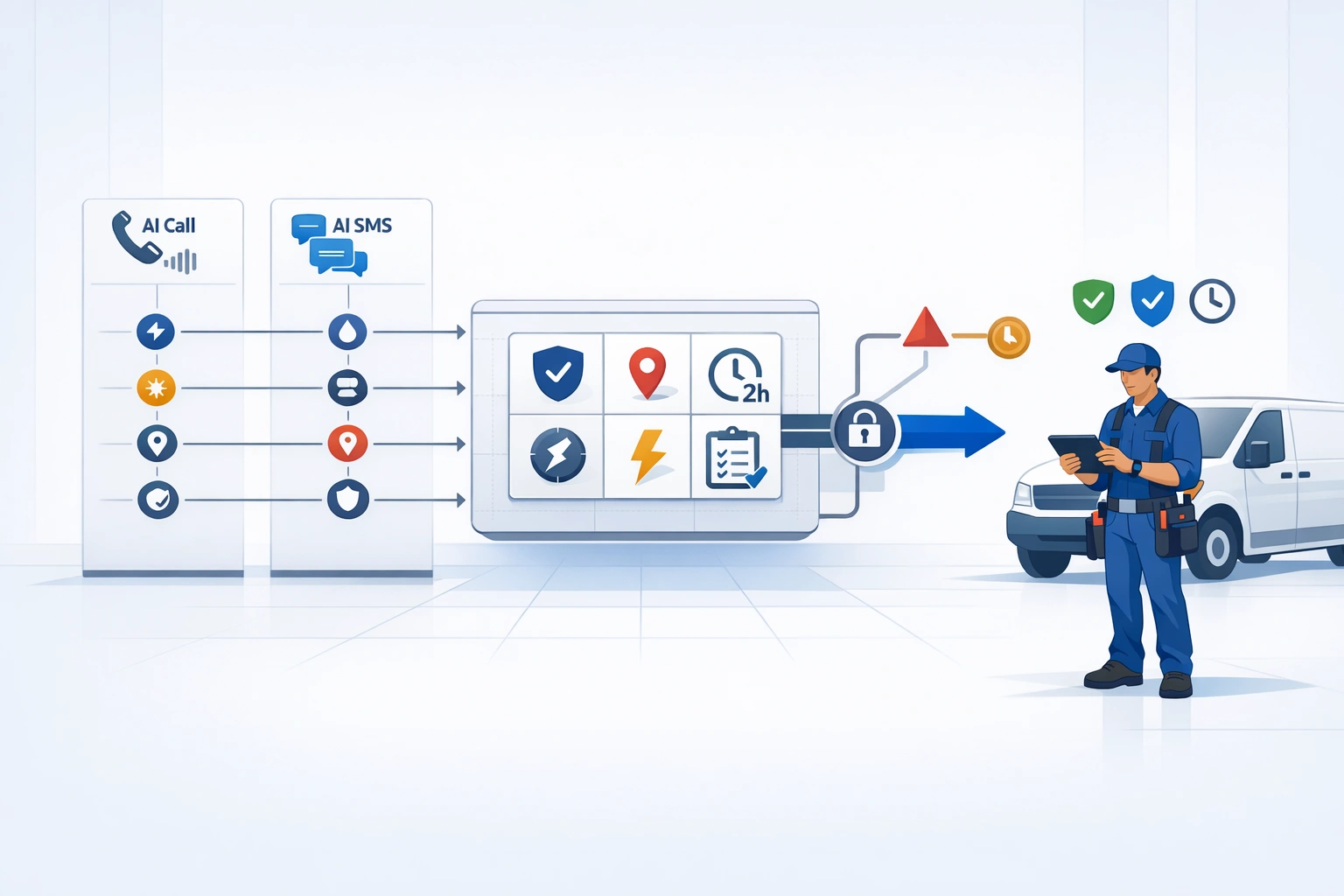
After-hours electrical calls are potential safety events. Your answering service must separate safety risk from routine work, set one clear next step, and hand off dispatch-ready details so teams do not call back for basics. In multi-crew ops, most losses come from missed safety cues, vague ETA promises, and missing access info.
Minimum 60-second triage: safety cue (sparks, burning smell, buzzing, hot outlets, smoke, water near wiring), power status (outage, breaker tripping), immediate action (can shut off breaker safely, vulnerable occupants), exact location and access, and a bookable two-hour window.
Rules: safety cues trigger on-call escalation; routine work gets booked or an owned callback window with SLA; out-of-territory closes cleanly. Governance: one lead one owner, trigger-on-state-change, dedupe follow-ups, structured CRM fields, and QA on script adherence and promise control. Tools like Convin can log outcomes and audit quality.
After-hours electrical calls are rarely “just a booking.” They can involve safety risk, property damage, or an anxious customer who needs a clear plan. That is why an electrician answering service should not be evaluated like a receptionist. It must triage safety vs routine, set a time-bound next step, and hand off to dispatch in a format that any teammate can execute without calling the customer again.
In multi-crew operations, the failure modes are consistent: urgency gets mis-tagged, time promises stay vague, and access details are missed, forcing a second call. That is how an electrician answering service can look “covered” on dashboards but still lose jobs in the real world.
A dependable electrician answering service makes safety triage repeatable, sets an owned callback window when immediate booking is not possible, and records dispatch-ready details as structured fields. When those basics are in place, repeat calls drop, duplicate outreach is avoided, and technicians arrive prepared. This guide gives the scripts, escalation thresholds, and dispatch rules to run your electrician answering service like a system.
See A “Dispatch-Ready Handoff” Example Format
What Automation Usually Fixes And What It Misses
General guidance: most teams use automation to stop missed calls and keep queues moving. That helps, but safety-first intake fails when automation captures only “what happened” and not “what must happen next.”
The Common Approaches Teams Try
Routing menus, basic call capture, and text confirmations can reduce abandons. Many setups also offer callbacks instead of hold. These are practical improvements, but they often miss the operational requirement that matters most in electrical after-hours:
- A “call back later” offer without a callback SLA creates false certainty
- Generic intake can miss safety cues and route a high-risk call as routine
- Free-text notes force dispatch to re-call just to confirm basics
- Without measurement, quality drifts by shift, vendor, and location
Automation helps when it enforces a consistent workflow. It hurts when it provides coverage without clarity.
Draft A Callback SLA Script That Removes “We’ll Call You”
This blog is just the start.
Unlock the power of Convin’s AI with a live demo.
Intake Script And Dispatch Rules You Can Run Tomorrow
Keep the workflow short, trigger-based, and anchored to state change. Each call should produce one clean, executable next step.
60-Second Safety Triage
Use this as the minimum intake checklist. It protects customers and technicians while keeping the call fast.
- Safety cue: sparks, burning smell, buzzing, hot outlets, smoke, water near electrical
- Power status: partial outage, full outage, breaker tripping, lights flickering
- Immediate action: can they switch off the breaker safely, can they reach the main shutoff, is anyone vulnerable on-site
- Location + access: exact address, unit, gate code, pets, parking constraints
- Bookable window: confirm a two-hour range, or move to a clear escalation path
Dispatch Rules That Prevent Repeat Visits
Turn intake into dispatch-ready decisions:
- If a safety cue is present, route to on-call using one clear escalation rule
- If it is routine, book or create an owned callback with a specific time window
- If out of territory, close as not serviceable and prevent duplicate outreach
Customer: The breaker keeps tripping and outlets feel warm.
Agent: I can help. Are you seeing sparks, smoke, or a burning smell right now?
Customer: No smoke, but there’s a hot smell.
Agent: Understood. Please turn off that breaker if it’s safe. Is anyone vulnerable at home?
Customer: Yes, my father is elderly.
Agent: Thanks. I’m escalating this to the on-call electrician for tonight. What’s your address and gate code?
Customer: 14 Meadow Lane, gate code 5521.
Agent: Confirmed. You’ll get one call within 15 minutes with an arrival plan. If anything changes, reply to the SMS and it escalates.
Takeaway: The fix is to lead with safety questions, then set a time-bound plan with one owner, not “someone will call.”
Standardize The 5 Questions That Prevent Unsafe Routing
The Shortlist Criteria That Matters In Real Operations
When choosing an electrician answering service, evaluate whether the system produces safety-correct outcomes and dispatch-ready handoffs under pressure.
Use this neutral checklist to compare options:
If you are evaluating this for your team, a one-page scorecard keeps decisions objective.
Benchmark Callback Integrity: Window, Owner, And Dedupe Rules
Maintaining Control In High-Risk After-Hours Moments
Safety does not fall apart because calls increase. It falls apart when multiple teams react without coordination and critical signals are not advanced with clarity. Staying “covered” is not enough. The flow must stay controlled when urgency rises.
To keep after-hours handling dependable:
- Designate one active responder per case so responsibility is never split across queues
- Move cases forward only on meaningful updates such as escalation flagged, return call requested, time window confirmed, or issue recorded
- Attach a defined response window to every return call with a named individual accountable for completion
- Limit follow-up duplication so one inbound event results in one coordinated response
- Store commitments in structured system fields including urgency level, action promised, and confirmation status
- Review recurring breakdowns routinely focusing on routing accuracy, timing clarity, and missed steps
When this discipline holds, safety-related requests reach the right hands quickly, dispatch receives usable context, and customers hear one consistent plan instead of mixed messages.
The outcome is straightforward: critical cues are recognized early, handoffs are actionable, and each customer leaves the call knowing exactly what will happen next.
Adopt “One Lead, One Owner” As A Hard Rule
FAQs
- Which safety cues should an electrician answering service escalate instantly?
A safety-first electrician answering service escalates burning smell, sparks, smoke, hot outlets, water near power, repeated trips, or outage with vulnerable occupants. - How does an electrician answering service avoid vague after-hours promises?
Use a two-hour callback window, one owner queue, and SLA tasking; the electrician answering service logs the promise as a field, not notes. - What dispatch handoff fields should an electrician answering service capture?
An electrician answering service should capture address, unit, access, safety cue, power status, job type, confirmed time window, and what the customer was told. - When should an electrician answering service route to on-call crew?
Route via electrician answering service when safety language appears or critical power loss occurs; create an on-call escalation task and share immediate shutoff guidance. - How can an electrician answering service keep safety triage consistent?
Use automated QA to score safety questions, promise control, and handoff completeness; the electrician answering service coaches recurring misses weekly, not quarterly.
How Convin Operationalizes Safety Intake And Dispatch
Convin can sit alongside your phone system, scheduling tools, and CRM as an operations layer that turns after-hours calls into trackable outcomes. The goal is not more tooling. The goal is consistent safety routing, clean dispatch handoffs, and owned follow-ups.
End-To-End: How Convin Runs Safety Intake To Handoff
Using capabilities confirmed in your provided product copy, Convin can support this workflow by:
- Detecting safety and urgency signals in the live call, such as “burning smell,” “sparks,” “breaker keeps tripping,” or “power is out”
- Logging a structured outcome in CRM, such as safety escalation, booked slot, callback requested with a time window, or not serviceable
- Triggering owned tasks with SLAs, so callbacks and escalations never depend on memory
- Running Automated QA and coaching signals to verify safety checks, promise control, and handoff fields are completed consistently
Operational Results When Convin Sits In Your Stack
With Convin integrated, dispatch receives a consistent, executable handoff instead of scattered notes. Follow-ups become time-bound and owned, reducing duplicate callbacks across teams. Supervisors can coach the specific miss that increases risk, like skipping a safety question or giving a vague ETA, because QA surfaces the pattern across calls.
"Customer: I smell something burning near the panel."
"Agent: Understood. Are you seeing sparks or smoke right now?"
"Customer: No smoke, but the smell is strong."
"Agent: What is your address and gate access details?"
"Customer: 88 Pine Street, gate code 1732."
"System record: Safety cue detected, on-call escalation created, access logged."
"Convin: Flags the safety cue, logs escalation in CRM, triggers on-call task, and QA checks safety-script adherence."
Takeaway: Weak setups treat safety language as “notes.” Do instead: treat safety cues as triggers that create an owned escalation and a logged outcome.